
Rules scoring, serve, time
Tennis Rules and Scoring: A Clear Beginner's Guide to How a Match Works
Tennis rules fit on a few pages, but the scoring trips up almost every beginner. Step through a simulated match below, from the first 15 to a 10-point tiebreak, then read how the serve, faults, lets and line calls work.
- Win a game
- 4points, two clear of the opponent
- Tiebreak at 6-6
- 7points, two clear
- Slam final set
- 10point tiebreak at 6-6, since 2022
Scoring
Tennis scoring, step by step
Short answerTennis scoring stacks three counts: points make a game (15, 30, 40, game), games make a set (first to six, two clear, or a tiebreak at 6-6), and sets make the match. Press Play, or step through with the arrow keys.
Most of the tennis rules a beginner needs are about scoring, and scoring is easiest to learn by watching it happen. The simulation below plays one match between Player A and Player B, point by point, with a real scoring engine counting behind it, and it tracks the games, decides who serves, from which side, when the players change ends and when a tiebreak starts. Every score on the board is computed, not typed in.

Points
Win the first point of a game and your score goes from love to 15.
| Player | Sets | Games | Points |
|---|---|---|---|
| Player A | – | 0 | 15 |
| Player B | – | 0 | 0 |
- umpire's call
- 15-love
- server's score first
- serving
- A
- alternates every game
- serving from
- ad court (left)
- even points right, odd points left
-
01 Points
Win the first point of a game and your score goes from love to 15.
Every game starts at love-all, the word tennis uses for zero. The player who wins the first point moves to 15. The umpire always calls the server's score first, so if the server wins it the call is 15-love, and if the receiver wins it, love-15. The server begins every game from behind the right half of the baseline, the deuce court.
Score after this step 15-love
-
02 Points
Two more points take the server to 40. One more point wins the game.
The second point won is called 30 and the third 40. Nobody knows for certain why the count runs 15, 30, 40; the theories about clock faces and old French court games have never been settled. What matters on court is simpler: a player on 40 who wins the next point wins the game, as long as the opponent is not also on 40.
Score after this step 40-love
-
03 Deuce
The receiver wins three straight points. Level at three points each is called deuce.
When both players have won three points, the score is not called 40-all but deuce. From deuce nobody can win the game with a single point. A game must be won by two clear points, so a long run of deuces is possible, and a single game can last ten minutes or more at the top level.
Score after this step Deuce
-
04 Deuce
From deuce a player needs two points in a row: advantage, then game.
The player who wins the point after deuce has the advantage. Win the next point too and the game is over; lose it and the score goes back to deuce. Here the server reaches advantage, gets pulled back to deuce, then wins two in a row. The receiver now serves the next game, because serve alternates game by game.
Score after this step Game A
-
05 Games
Games build a set: first to six games, two clear, so this one ends 6-4.
Each game won adds one to the games column. The first player to win six games, with a margin of at least two, wins the set. In this set both players hold serve until the tenth game, when the first player wins the opponent's service game, a break, and closes the set 6-4. Players change ends after the first game and every odd game after that.
Score after this step 6-4 · Game and set A
-
06 Tiebreak
Both players hold every game. At 6-6 the set goes to a tiebreak.
If neither player gets two games clear, the set would run on forever, so almost every event uses a tiebreak once the games reach six-all. The tiebreak counts as one final game of the set. Its winner takes the set 7-6, and the tiebreak points of the loser are written in brackets after the score, as in 6-7(5).
Score after this step 6-4 · Six games all, tiebreak · tiebreak 0-0
-
07 Tiebreak
Tiebreak: first to 7 points, two clear. Here the second player wins it 7-5.
Tiebreak points are counted one, two, three, not 15, 30, 40. The player due to serve takes the first point from the right, then the serve passes to the opponent for two points, and from then on each player serves two in a row. Ends change after every six points. This one goes level to five-all before the second player wins two straight.
Score after this step 6-4 6-7(5) · Game and set B · tiebreak 5-7
-
08 Without a tiebreak
With no tiebreak, a final set can run to 70-68, as Isner and Mahut's did.
Before tiebreaks were used in deciding sets at Wimbledon, the final set was an advantage set with no limit. Run the same engine with the tiebreak switched off and two players who always hold serve can reach any score. John Isner beat Nicolas Mahut 70-68 in the fifth set at Wimbledon in 2010, after a match of 11 hours and 5 minutes over three days.
Score after this step 70-68 · Game, set and match A
-
09 Final set
One set each, and the deciding set reaches 6-6 as well.
With a set each, the third set decides a best-of-three match; in a best-of-five match the same happens at two sets all. Since the 2022 French Open all four Grand Slams have used the same rule here: at six games all in the final set, the players play a longer tiebreak, first to ten points instead of seven.
Score after this step 6-4 6-7(5) · Six games all, tiebreak · tiebreak 0-0
-
10 Final set
The final-set tiebreak runs to 10 points, two clear. The first player wins it 10-8.
The ten-point tiebreak works like the seven-point one: the serve rotates after one point and then every two, and the ends change every six points. The only difference is the target, which leaves more room for a comeback. The match ends here, written as 6-4, 6-7(5), 7-6(8): the final tiebreak was won 10-8.
Score after this step 6-4 6-7(5) 7-6(8) · Game, set and match A
The scoring engine follows the ITF Rules of Tennis: games, tiebreak sets, the serving order in a tiebreak and the change of ends. Sources: ITF: Rules of Tennis 2026; Reuters (via Business Day): all four Grand Slams to trial 10-point final-set tiebreak, March 16, 2022; Guinness World Records: longest professional tennis match.
Why 15, 30, 40
Where the odd numbers in tennis scoring come from
Short answerNobody knows for certain. The clock-face story is the one most often told, but the origin of 15, 30, 40 has never been documented.
The scoring system came to lawn tennis from older French and English court games, and the explanations for it are all guesses. The best-known one says points were once kept on a clock face, moved a quarter-hour at a time to 15, 30 and 45, with 45 later shortened to 40 because it is quicker to say. Another links the numbers to wagers in jeu de paume, the indoor game that real tennis grew out of. Neither has a source that settles it. How lawn tennis itself began, from a patent in 1874 to the first Wimbledon in 1877, is told in when tennis was invented.
What the rules do say is plain. Rule 5 of the ITF Rules of Tennis lists the calls as love, 15, 30, 40 and game, defines deuce as three points each, and requires two points in a row from deuce to win the game. It also allows a "No-Ad" alternative, where at deuce one deciding point is played and the receiver chooses which side to receive on. That version is common in college and club doubles, and on the professional tours it is used in doubles alongside a ten-point match tiebreak in place of a third set.
One practical tip for beginners: the server's score is always called first. If the server has won no points and the receiver two, the call is "love-30", not "30-love". Get that wrong in a friendly match and you will hear about it.
The serve
How to serve in tennis: the rules every beginner needs
Short answerStand behind the baseline, between the centre mark and the sideline, toss the ball and hit it before it lands. It must land in the service box diagonally opposite. You get two attempts.
Every point in tennis starts with a serve, and the rules for it are stricter than for any other shot. Under Rule 16 the server stands at rest with both feet behind the baseline and inside the imaginary extensions of the centre mark and the sideline, releases the ball by hand and hits it with the racket before it touches the ground. Serving underarm is legal, and so is tossing with either hand.
The first point of every game is served from the right half of the court, the deuce court, and the server then alternates sides every point. The serve has to clear the net and land in the service box diagonally opposite, lines included. In singles the box is bounded by the singles sideline; the doubles alleys are out for the serve even in doubles.
The same player serves the whole game, and the serve passes to the opponent for the next one. Winning a game on your own serve is a hold; winning one on the opponent's serve is a break, and in professional tennis a single break is often enough to decide a set. The receiver can stand anywhere on their side but must let the serve bounce before playing it.
Where the feet go during the motion has its own rule, and breaking it is a foot fault: touching the baseline or the court inside it before the ball is struck, or straying past the centre mark or sideline extensions.
Where a serve has to land
From the server's side of the court. The ball must cross the net and land in the service box on the other side of the diagonal, lines included.
- 1 Stand behind the baseline, between the centre mark and the sideline.
- 2 Serve the first point from the right (deuce) side, then alternate.
- 3 Land the ball in the box diagonally across the net.

Faults and lets
Faults, double faults and lets
Short answerA serve that misses the box, hits the net and stays on the server's side, or breaks the serving rules is a fault. Two faults in a row lose the point. A serve that clips the net and lands in is a let and is replayed.
A fault is a failed serve. Rule 19 counts as a fault any serve that lands outside the correct service box, goes into the net, misses the ball entirely, hits a net post or singles stick, or is struck in breach of the serving rules. After a first-serve fault the server gets a second serve from the same side; after a second fault the point goes to the receiver. That is a double fault.
A let is a replay. If the serve touches the net, strap or band and still lands in the correct box, it is a service let and the server repeats that serve. A let does not wipe out an earlier fault, so a let on the second serve is still a second serve. A let can also be called during a rally when something outside the players' control interrupts it, such as a ball rolling onto the court from the next one, and then the whole point is replayed.
During a rally the rules are simpler than they look. You lose the point if the ball bounces twice on your side, if your shot lands out or in the net, if you touch the net or the opponent's court while the ball is in play, if you hit the ball before it has crossed to your side, or if the ball touches you or your clothing. A ball that hits the net cord in a rally and drops over is good, and play goes on.
Fault, let or double fault
The four things that can happen to a serve, in the order a server meets them.
-
Lands in the box
Play on
The ball clears the net and lands in the diagonal service box, lines included. The point is played out.
-
Clips the net, lands in the box
Let: replay
A service let. The server repeats that serve, and an earlier fault still stands.
-
Lands outside the box, or in the net
Fault
The first fault gives a second serve. A foot fault or a missed ball also counts.
-
A second fault
Double fault
The server loses the point. The receiver scores and the serve is not repeated.
Line calls
Is a ball on the line in or out?
Short answerIn. Under Rule 12 a ball that touches any part of a line counts as landing in the court that line bounds.
The lines are part of the court. A ball that touches even the outer edge of the baseline is good, which is why a fraction of a millimeter of fuzz on the paint can decide a Grand Slam point. At the top level that decision is now mostly made by cameras. Wimbledon replaced its line judges with electronic line calling from the 2025 Championships, and the ATP moved all of its tour events to electronic calls in the same year.
On a park court nobody has a camera. The USTA's code for unofficiated matches puts the job on the players, so each player calls the lines on their own side, and a ball that cannot be called out with certainty is good. Calling "out" late or "maybe out" is not an option. If you are not sure, it is your opponent's point, and that single principle prevents most of the arguments at club level.
On the line is in
The line is part of the court. The ball is judged by its mark, and any part of the mark touching any part of the line counts.
-
Centre on the line
In
-
Touches the edge
In
-
Misses by a hair
Out
-
Well past it
Out
Time
How much time players get between points
Short answerThe ITF rules allow 20 seconds between points, 90 seconds at a change of ends and 120 seconds between sets. The ATP, WTA and Grand Slams use 25 seconds between points, shown on a visible shot clock.
- 20sec Between points ITF Rules of Tennis
- 25sec Between points ATP, WTA and Grand Slams
- 90sec Change of ends after odd games
- 120sec Set break end of each set
Time limits are where the amateur rules and the professional rules split. Rule 29 of the ITF rules gives a maximum of 20 seconds between points, 90 seconds when the players change ends and 120 seconds at the end of a set, measured from the end of one point to the strike of the next serve. After the first game of a set and during a tiebreak there is no sitting down, so players change ends without a break.
The tours wrote their own number. The ATP rulebook allows 25 seconds between points, and the Australian Open put a visible 25-second serve clock on court in 2018. Run over and the umpire gives a time violation warning, then takes a first serve away from a server or a point from a receiver. Those penalties are explained in the guide to code violations in tennis.
Doubles
Tennis rules for doubles
Short answerDoubles uses the wider court with the alleys, the four players take turns serving game by game, and each team chooses who receives in the deuce and ad courts for the whole set.
The doubles court is 10.97 meters wide instead of 8.23, so the alleys along each side are in play once the serve has landed. The serve itself still has to land in the normal service box. The serving team decides which partner serves the first game, the opponents decide for the second, and the order then rotates through all four players for the rest of the set.
On the receiving side, each team picks who receives in the deuce court and who in the ad court, and keeps that order for the set. After the return either partner can play the ball, and the partners can stand wherever they like. The scoring is the same as in singles, apart from the No-Ad and match tiebreak options that many events use to keep doubles short.
The court in numbers
One court, two widths: the alleys are out for singles and in for doubles.
Rules explained
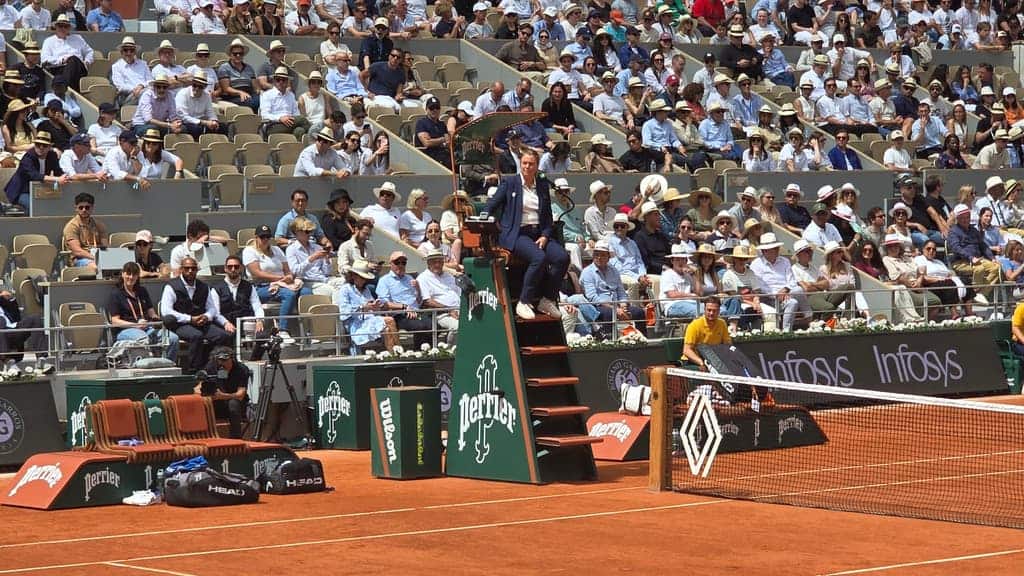
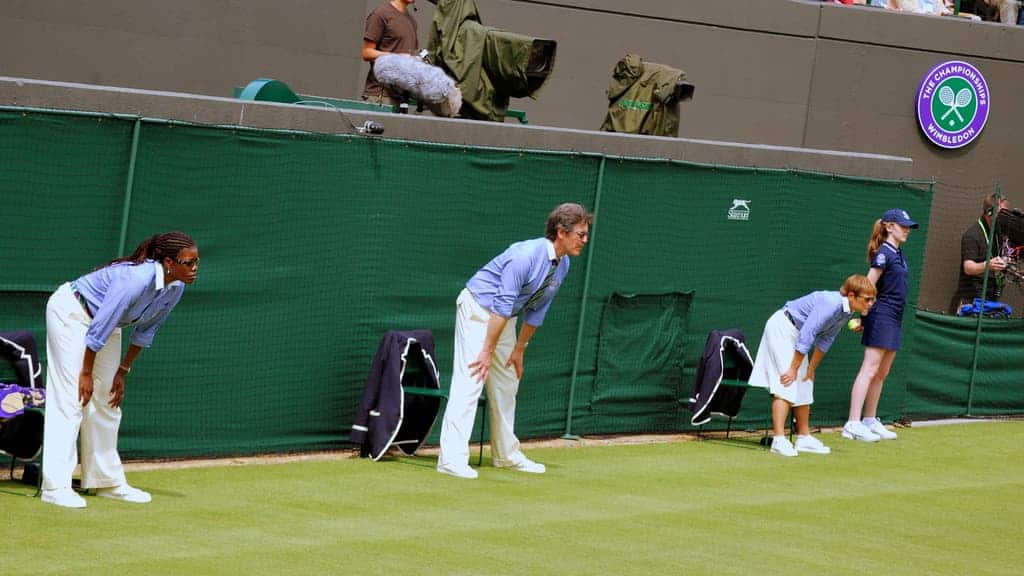
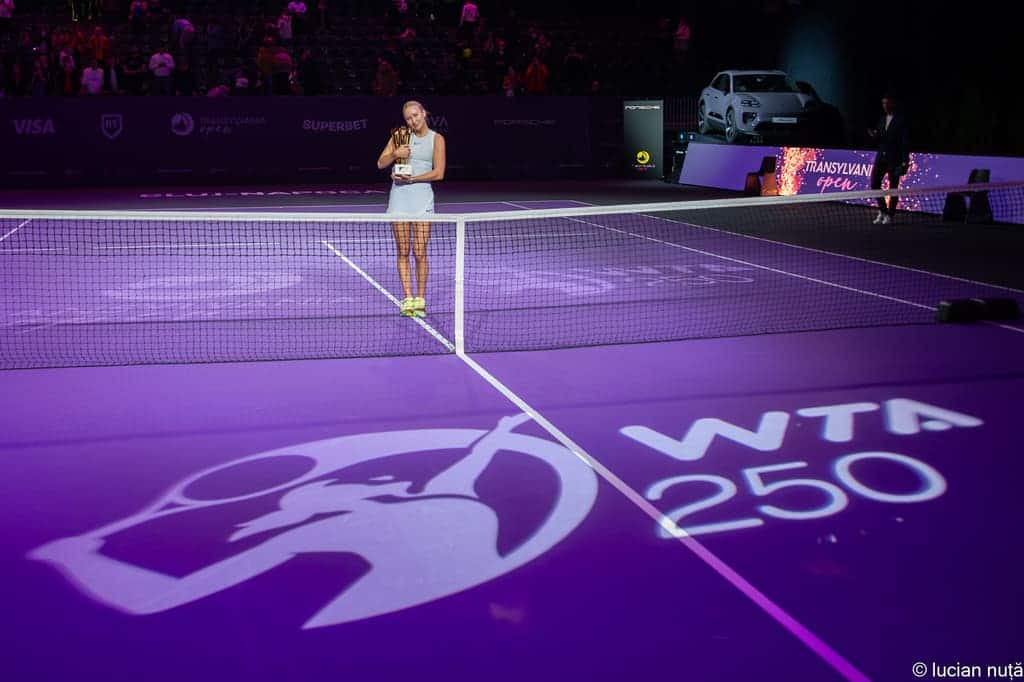
Three tennis rules that cause the most arguments
Short answerCode violations, foot faults and the best-of-three format for women produce more questions than any other part of the rulebook. Each has its own explainer.
-
-
-


Each of these grew out of a real match. Serena Williams lost the 2009 US Open semifinal after a foot fault call set off an argument with a line judge, and Novak Djokovic was defaulted from the 2020 US Open for hitting a ball that struck a line judge. The rules involved are short; the arguments about them are not.
250, 500 and 1000
What the difference is between 250, 500 and 1000 events
Short answerThe number is the ranking points the singles champion earns. A 250 event gives the winner 250 points, a 500 gives 500, a Masters 1000 or WTA 1000 gives 1,000, and a Grand Slam 2,000.
- 250250 events29 ATP 22 WTA
- 500500 events16 ATP 17 WTA
- 1000Masters 1000 and WTA 10009 ATP 10 WTA
- 1500Season finalsATP and WTA Finals, unbeaten champion
- 2000Grand Slams4, shared
The rules of tennis are the same at every level, but the tournaments are not. On both tours the category number is the champion's ranking points, which is also a rough guide to the prize money and the strength of the field. Players ranked high enough are obliged to play most of the 1000 events, while the 250s and 500s fill the weeks around them. The tournaments guide explains each tier and how the draws work, and the tennis calendar shows which events are on this week.
FAQ
Tennis rules: questions and answers
Short answerShort answers to the questions beginners ask most about tennis rules, scoring and the serve.
What are the basic tennis rules?
Players hit the ball over the net into the opponent's court, and a point ends when someone cannot return it legally: the ball bounces twice, lands out, or goes into the net. Each point starts with a serve from behind the baseline, diagonally into the service box. Points make games, games make sets, and a match is best of three or best of five sets.
How does tennis scoring work for beginners?
A game is counted 15, 30, 40, game. At 40-40 the score is deuce and a player needs two points in a row to win the game. The first to six games, two games clear, wins the set; at six games all a tiebreak to 7 points decides it.
Why is tennis scored 15, 30 and 40?
No one knows for certain. The most repeated explanations involve clock faces used to keep score in medieval France and the old French game of jeu de paume, but none is documented well enough to settle the question. The rules simply define the calls.
What does love mean in tennis?
Love means zero. A game score of 15-love means the server has won one point and the receiver none, and love-all means 0-0.
How many serves do you get in tennis?
Two. If the first serve is a fault, the server gets a second serve from the same side. Two faults in a row are a double fault and lose the point. A serve that clips the net and lands in the right box is a let and is replayed without using up a serve.
What is not allowed in tennis?
Under the ITF tennis rules a player loses the point for touching the net or the opponent's court while the ball is in play, hitting the ball before it has crossed the net, letting it bounce twice, carrying or double-hitting it on purpose, or being hit by the ball. Racket abuse, obscenities and stalling are punished separately under the code of conduct.
What is the golden rule of tennis?
In matches without officials, the USTA's code for unofficiated play sets the principle most players mean by it, which is that you call the lines on your side, and any ball you cannot clearly see out is good for your opponent.
How does a tiebreak work in tennis?
At six games all, players play a tiebreak counted one, two, three. The first to 7 points with a two-point lead wins the set 7-6. The serve switches after the first point and then every two points, and the players change ends every 6 points. In the final set of a Grand Slam the tiebreak runs to 10 points.
How long is a tennis match?
There is no game clock in tennis, so a match lasts as long as the points do. A one-sided best-of-three match can be over in about an hour, and a close best-of-five match can run for five. The 2012 Australian Open final between Novak Djokovic and Rafael Nadal took 5 hours and 53 minutes. The longest on record, John Isner against Nicolas Mahut at Wimbledon in 2010, lasted 11 hours and 5 minutes.
Can you hit the ball before it bounces in tennis?
Yes, during a rally you may volley the ball before it bounces, as long as you hit it on your side of the net. The one exception is the serve, where the receiver must let the serve bounce before returning it, or loses the point.