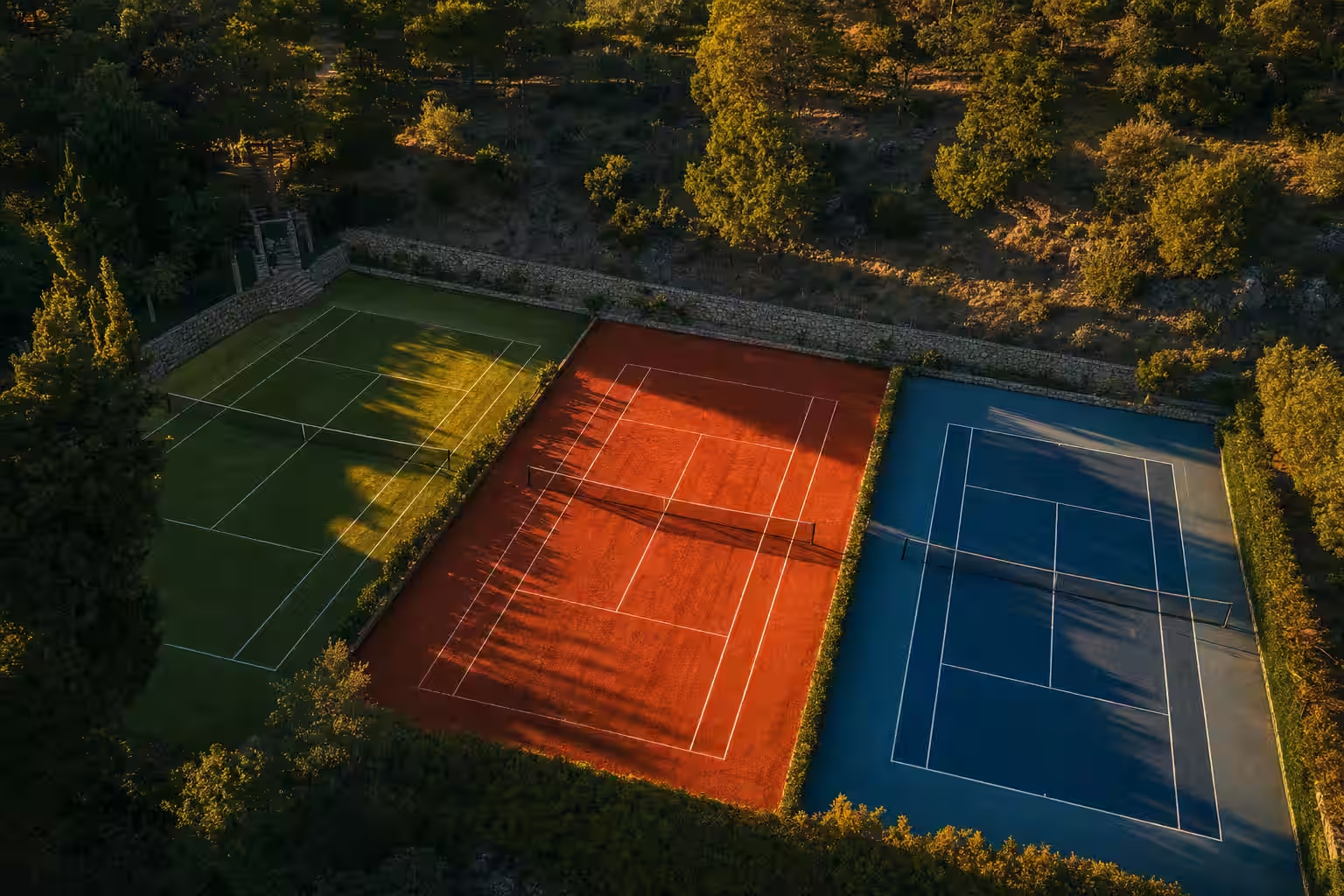
Courts Grass, clay and hard courts
Tennis Court Surfaces: How Grass, Clay and Hard Courts Change the Game
Three tennis court surfaces carry the whole professional season. The ball skids on grass, sits up on clay and does something in between on a hard court, and those differences decide who wins where.
- Grand Slam surfaces
- 3grass, clay and two hard courts
- ITF pace classes
- 5from slow to fast
- Court length
- 78 ft27 ft wide for singles
The three surfaces
Tennis court surfaces: grass, clay and hard courts
Short answerThere are three tennis court surfaces on the pro tours: grass, clay and hard courts. Grass is the fastest and keeps the ball low, clay is the slowest with the highest bounce, and hard courts sit in the middle.
Every tennis court in the world has the same lines, the same net and the same size. What changes is the ground under the ball. On grass the ball skids and stays low. On clay it bites into the surface, slows down and kicks up. A hard court is a coat of acrylic over asphalt or concrete, and its pace depends on how much sand the builder mixes into the paint.
That one variable shapes careers. Rafael Nadal won Roland Garros 14 times on clay; Roger Federer won Wimbledon eight times on grass. Pick a surface below and watch the same shot land on each of them.

- Pace
- Fast: the ball keeps most of its speed
- Bounce
- Low, and lower still when the grass is fresh
- Grand Slam
- Wimbledon, the only grass-court major
- What changes
- Short points, big serves and slices that stay down. The courts wear to bare earth around the baselines by the second week, and the bounce gets truer as they do.
- Pace
- Medium, but it varies from event to event
- Bounce
- True and predictable
- Grand Slam
- Australian Open and US Open
- What changes
- The default surface of the tour. The builder controls the pace through the texture of the acrylic top coat, so one hard court can play much quicker than another.
- Pace
- Slow: friction takes speed off the ball
- Bounce
- High, especially with heavy topspin
- Grand Slam
- Roland Garros, on red clay
- What changes
- Long rallies, sliding into the ball and a premium on fitness. Clay also leaves a mark where the ball lands, which umpires can check on line calls.
Grass
Grass courts: fast, low and gone in a few weeks
Short answerGrass is the fastest surface and the oldest. The ball skids through low, the serve is worth more than anywhere else, and the professional grass season lasts only a few weeks around Wimbledon.
Lawn tennis started on grass, which is why the game still carries the word; our piece on when tennis was invented goes back to the first garden courts of the 1870s. Today grass is the rarest of the three. A grass court needs daily mowing, rolling and watering, and it can only be played on for part of the year, so the tours fit their grass events into the short stretch between Roland Garros and Wimbledon.
Wimbledon's courts have been 100% perennial ryegrass since 2001, cut to 8 mm for the Championships. Ryegrass is hard-wearing, which helps on a surface that takes two weeks of sprinting and sliding. Players describe the first days as the quickest, before the baselines wear down to dry earth and the ball starts to sit up.
Grass rewards first-strike tennis, such as a heavy serve, a sliced backhand that stays under knee height, a volley behind an approach. That is why big servers often do their best Grand Slam work at Wimbledon, and why clay specialists sometimes skip the grass swing altogether.


Clay
Clay courts: slow, high and sliding
Short answerClay is the slowest surface. The loose top layer grips the ball, takes speed off it and throws it up, so rallies last longer and fitness and topspin count for more.
A red clay court is a layered build. At Roland Garros the build is about 80 cm deep: 1-2 mm of crushed brick on top, then 6-7 cm of crushed limestone, 7-8 cm of clinker and at least 30 cm of gravel over the drainage. Only the thin top layer of brick dust is what players see. The limestone beneath holds water, which keeps the clay from turning to dust in the sun, and that is why ground staff water the courts between matches.
Most of the clay season is in Europe in April and May: Monte-Carlo, Madrid, Rome, then Paris. Club players in the US meet a different version, green clay, which is firmer underfoot than the red brick dust of Europe.
One odd footnote: in 2012 the Madrid Open painted its clay blue for better contrast on television. Players hated how slippery it was, and the tournament went back to red the next year.

Hard courts
Hard courts: the surface most of the tour is played on
Short answerHard courts are acrylic coatings over asphalt or concrete. They host two of the four Grand Slams and most of the tour calendar, and they give the truest, most predictable bounce.
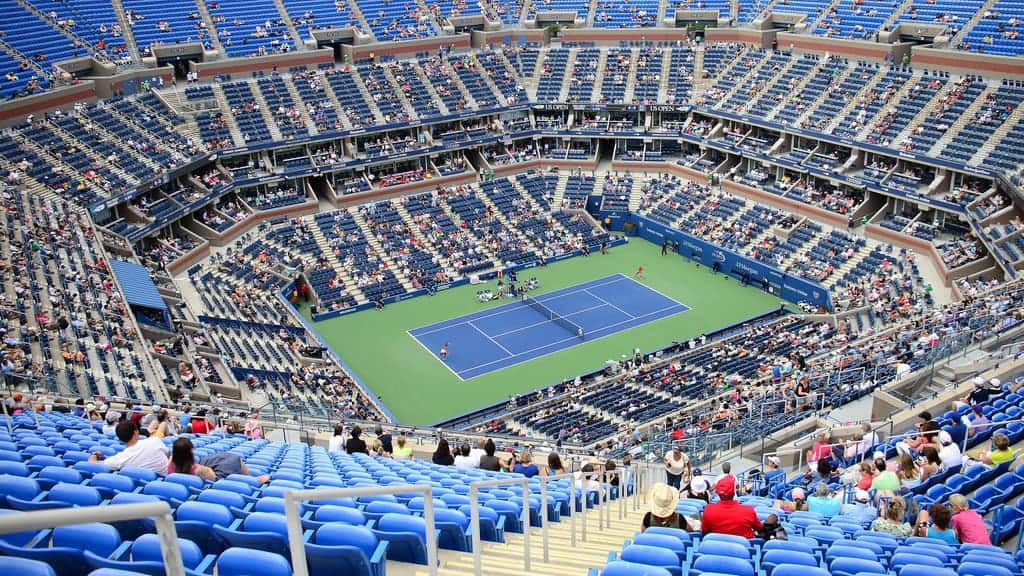
A hard court is a slab of asphalt or concrete with layers of acrylic paint on top. Sand mixed into the top coat sets the friction, so more sand means a slower court. Some, like the courts in Melbourne, add a cushioned layer under the paint, which is easier on the joints. The US Open has used courts from the Laykold brand since 2020, the first change of supplier in New York since 1978.
Hard courts are cheap to maintain and play the same in most weather, which is why they dominate. Most outdoor events from August to October are on hard courts, and nearly every indoor event of the autumn is too. If you play at a public park in the US, the court under your feet is almost certainly one.

Grand Slam surfaces
Which Grand Slam is played on which surface
Short answerThe Australian Open and the US Open are played on hard courts, Roland Garros on red clay and Wimbledon on grass. Below, every Grand Slam and 1000-level event of the season by surface.
Grand SlamAustralian OpenUS Open
1000 levelQatar OpenDubai Tennis ChampionshipsIndian Wells OpenMiami OpenCanadian OpenCincinnati OpenChina OpenShanghai MastersWuhan Open
Grand SlamRoland Garros
1000 levelMonte-Carlo MastersMadrid OpenItalian Open
The Grand Slam surfaces have not always been fixed. The US Open was played on grass until 1974, switched to clay for three years and has been on hard courts since 1978. The Australian Open plays on cushioned acrylic at Melbourne Park, where the main stadium has had a retractable roof since it opened in 1988. Wimbledon is the only major still on the surface the game began on. For the four tournaments side by side, see our Grand Slams guide.
Court pace
How the speed of a court is measured
Short answerThe ITF rates courts with its Court Pace Rating, in which a ball is fired at the surface and timed before and after the bounce. Courts fall into five classes, from slow to fast.
Players talk about fast and slow courts all the time, but there is an official number behind it. The ITF's Court Pace Rating measures two things: how much horizontal speed the ball loses through friction and how high it bounces. In the ITF's words, rougher surfaces slow the ball, and surfaces with a higher bounce "play slower because players have more time to reach the ball."
The test uses an air cannon and timing gates at several points on the court. The rating then puts the surface into one of five classes: slow, medium-slow, medium, medium-fast, fast. Each class covers a five-point band; a medium-fast court, for example, rates 40-44. Broadcasters sometimes show a different figure, the Hawk-Eye Court Pace Index, which also folds in weather and the balls, so the two numbers do not always agree.
Court size
How big a tennis court is, on every surface
Short answerA tennis court is 78 feet long and 27 feet wide for singles, 36 feet for doubles. The net is 3 feet high at the center and 3 feet 6 inches at the posts.
The ITF Rules of Tennis fix the court, not the surface. Whether the lines are painted on acrylic, taped into clay or chalked on grass, the rectangle is the same: 78 by 27 feet for singles, with the doubles alleys adding 4.5 feet on each side. The space around the lines is where venues differ, and big show courts leave far more room behind the baseline than a club court does. The baseline counts most at the serve, because a server who touches it before hitting the ball commits a foot fault.
Finding a court near you is usually a question for your city's parks department or a local club, and most public courts in the US are hard courts. Rain is the other everyday question. Hard courts can be squeegeed and played on soon after a shower, while clay and grass need longer, which is why the big outdoor venues on those surfaces have built roofs.
The court in numbers
One court, two widths: the alleys are out for singles and in for doubles.
Famous courts
The most famous courts in tennis
Short answerThe All England Club's grass courts and the red clay of Stade Roland Garros are the two most famous sets of courts in tennis. Each has its own guide below.
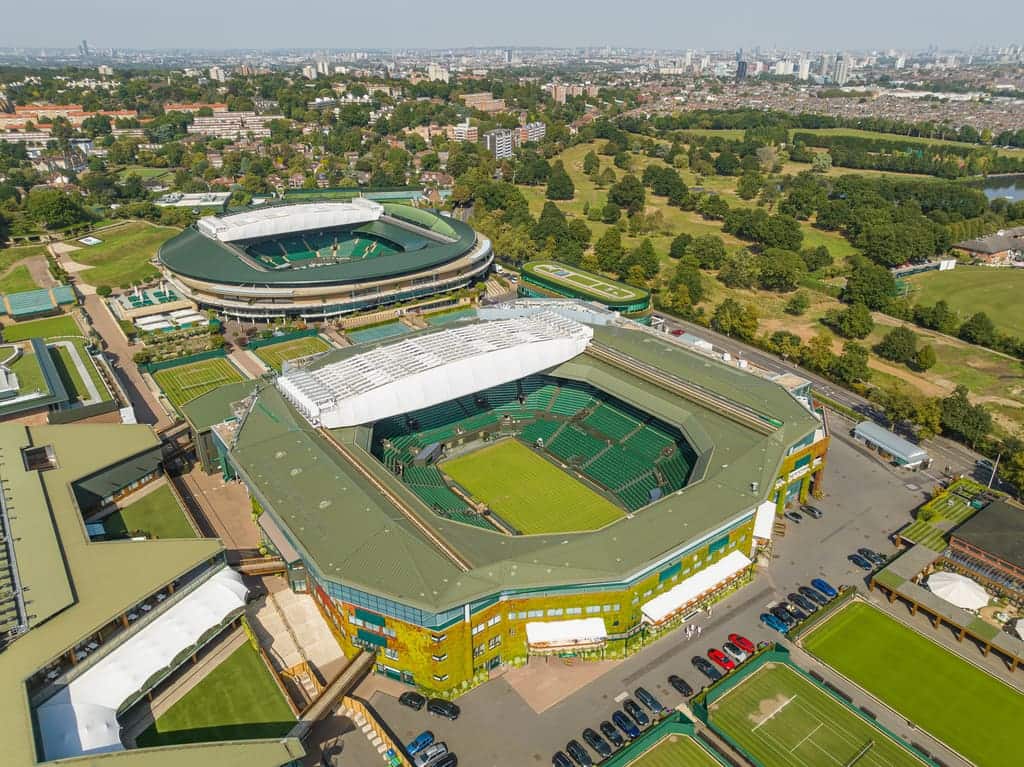
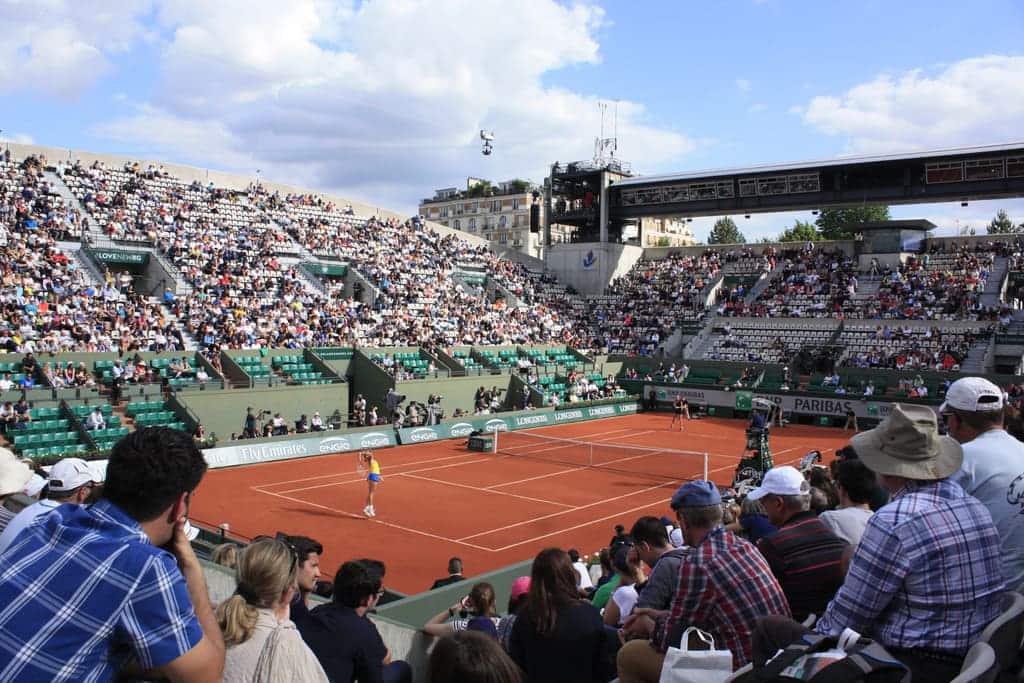
A venue is more than its surface. Wimbledon has 18 grass Championship courts and a separate practice ground; Roland Garros fits its clay courts and three roofed or sunken show courts onto a tight site in western Paris. Our two court guides cover every show court, its seats and its roof.
-
-
-
-


FAQ
Tennis court surface questions, answered
Short answerShort answers to what players and fans ask most about grass, clay and hard courts.
What are the different types of tennis court surfaces?
The professional game uses three tennis court surfaces: grass, clay and hard courts, which are acrylic layers over asphalt or concrete. Indoor tournaments are almost always on hard courts. Club courts add artificial grass and other synthetic surfaces, but the tours do not use them.
What is the toughest surface to play tennis on?
It depends on the player, but clay is usually called the most demanding physically, because the slow, high bounce makes points longer and asks for sliding and patience. Grass is the hardest to adapt to quickly, since the grass season lasts only a few weeks a year.
Which Grand Slam is played on which surface?
The Australian Open and the US Open are played on hard courts, Roland Garros on red clay and Wimbledon on grass. The US Open itself has used all three, grass until 1974, clay from 1975 to 1977 and hard courts since 1978.
Which tennis court surface is the fastest?
Grass. The ball skids through low and keeps more of its speed after the bounce, which rewards big serves and short points. Clay is the slowest, and hard courts sit in between, though their pace varies a lot from event to event.
Why is clay slower than other tennis court surfaces?
Loose clay grips the ball and takes speed off it, and the bounce is higher, so players get more time. The ITF counts both effects when it measures court pace, since friction slows the ball and a higher bounce gives the receiver longer to reach it.
What is the best surface for a home or club tennis court?
For most clubs and parks, an acrylic hard court, because it needs the least daily care and plays the same in most weather. Clay and natural grass are kinder on the body but need regular brushing, watering, rolling or mowing.
How big is a tennis court?
78 feet long and 27 feet wide for singles, 36 feet wide for doubles, under the ITF Rules of Tennis. The net is 3 feet high at the center and 3 feet 6 inches at the posts, whatever the surface.
Has the Madrid Open really been played on blue clay?
Yes, once. The 2012 Madrid Open used blue clay for a single edition, and the tournament went back to red clay in 2013 after players complained about how slippery it was.